
STANDARD CAPTURE
Every image is becoming free to fake. That puts a price on proof.
This is the long version of the argument behind Bizbio: what changed, who ends up paying for a verified record, and why the work underneath it only gets more necessary from here. It describes a business; it is not an offer to buy or sell anything, and nothing here promises a return.
The trust recession
Generative models have made any image, any voice and any video cheap to fabricate. The cost of believing something is now higher than the cost of making it. Insurers, municipalities, courts, newsrooms and AI labs are each absorbing that cost today — as disputes, as fraud, as re-work, as data they cannot legally use. Each improvement to those models moves the line the same way.
Who actually pays
What compounds
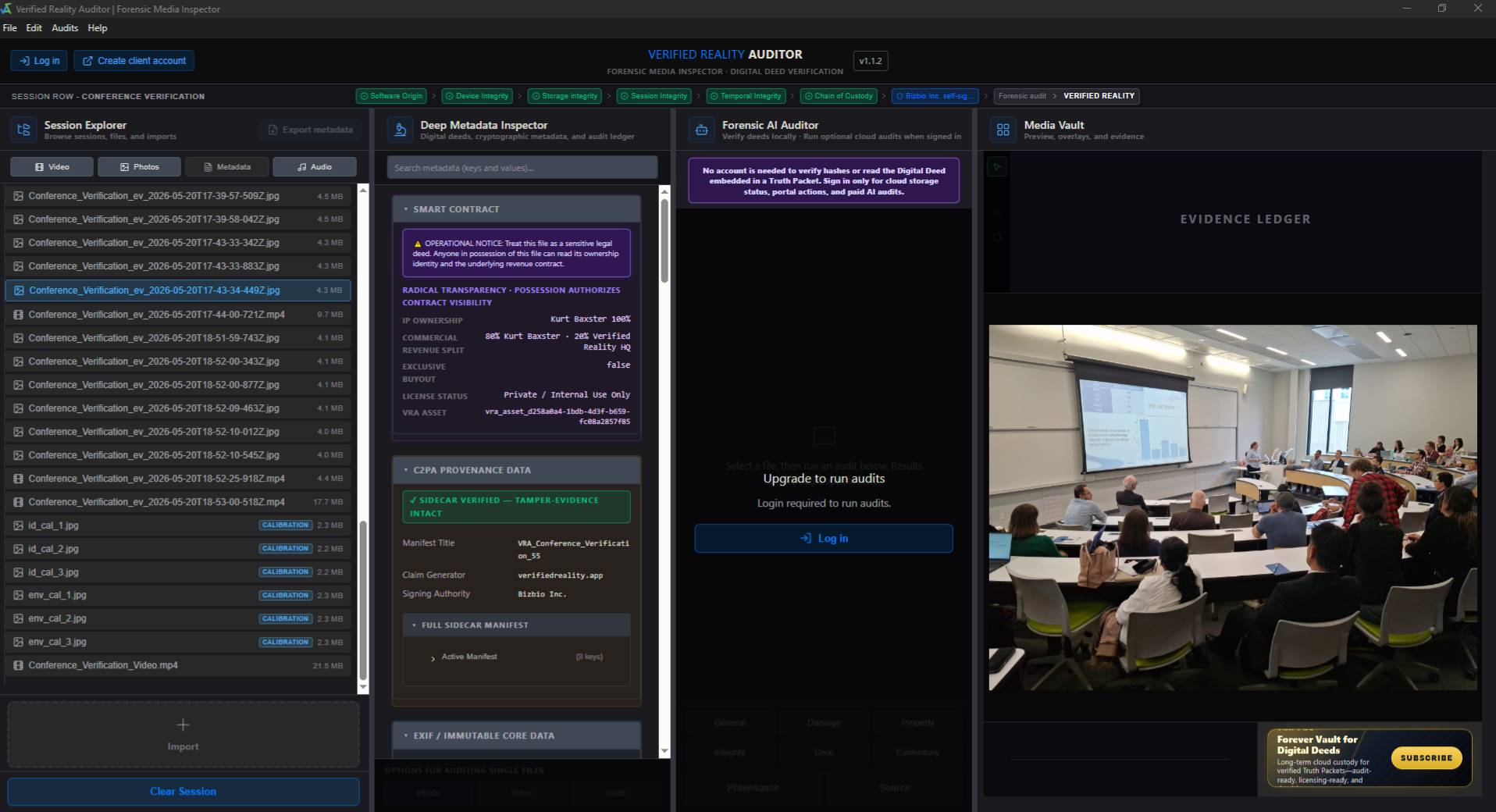
Bizbio Creative makes the media and seals it at the source — film, animation and capture from one crew. Verified Reality™ supplies the attestation, the ledger and the free auditor anyone can check. Newsload publishes through the same standard. Independent verifiers supply the feet on the ground, earning on every engagement.
What the 2026 federal budget changed
On 5 November 2026 the federal government tabled its 2026 budget, and it moved part of the cost of adopting a verified record onto the tax return — for any buyer, on the equipment and software a capture runs on; for a newsroom, on the wages it pays. Section 02 lists the parties absorbing the cost of a world where any image can be fabricated; the budget is the state joining them.
The capital side. The Productivity Mega Deduction makes immediate expensing permanent for most business equipment and software, so the full cost of an eligible asset can be deducted in the year it is put to use instead of over several years. It applies to most depreciable property acquired on or after 15 September 2026; buildings, licences and goodwill are not eligible. It is a deduction, not a payment: nothing changes hands.
The newsroom side. The Canadian Journalism Labour Tax Credit is extended to qualifying private audio and audiovisual news organisations at the same 35% rate written news has had, through the end of 2028. It is a refundable credit claimed by the news organisation against the wages it pays, and a designation comes first — an organisation has to be recognised as a qualified Canadian journalism organization before it can claim it at all. It is not a credit on equipment, and nothing a buyer purchases from Bizbio creates eligibility for it.
Neither measure changes what a sealed record proves. They change what it costs to start keeping one.
Both measures are described here the way the government describes them, and the Canada Revenue Agency decides whether a given asset or applicant qualifies. Nothing on this page is tax advice. The longer version, with every figure traced to its source, is our note on the measure.
What doesn't change
Whatever the models learn to do next, a photograph still comes from somewhere. Someone stood there, at a time, with a device. That is the one thing about a real event no generator can supply from scratch, and it is what a sealed capture records: the place, the time, the device, the file, and a seal that can be re-checked by anyone, years later, without asking us to vouch for it.
So this is not a bet on a model being defeated, or on a detection tool staying ahead. Detection will keep improving, and so will the faking; the two are the same race. A record sits outside that race. It answers a different question — not whether an image looks fake, but where it came from — and that question does not change when the models do.
That is the part worth building now. Fabrication keeps getting cheaper, and nothing on the horizon reverses it. Institutions that have to decide facts — an insurer, a court, a newsroom, a lab licensing data — will need something to decide them on, rather than another opinion about which picture looks real. That layer has to exist. The only open question is who builds it, and whether it is built to be checked rather than trusted.
Footage licensing
A second line of business, and a different kind of buyer. Media Bizbio shot itself is licensed on to labs, newsrooms and archives — real, crew-shot material from a physical archive, not scraped from the web.
Terms are conditional eligibility for secondary licensing revenue — never a promise of income.
What this page is not
This page describes a business and what it does. It is not an offer to buy or sell anything, there is no promise of a return, and no figure here is a projection of profit. Nothing on this site is advice about anyone's money. The economics of the verifier network — its rates, its cuts and the split behind them — are published where that business lives, at verifiedreality.ca, and are set by HQ.