
The Origin of the Verified Reality™ Pantheon
2026-11-16 · BY BRYAN BAKKER
 R
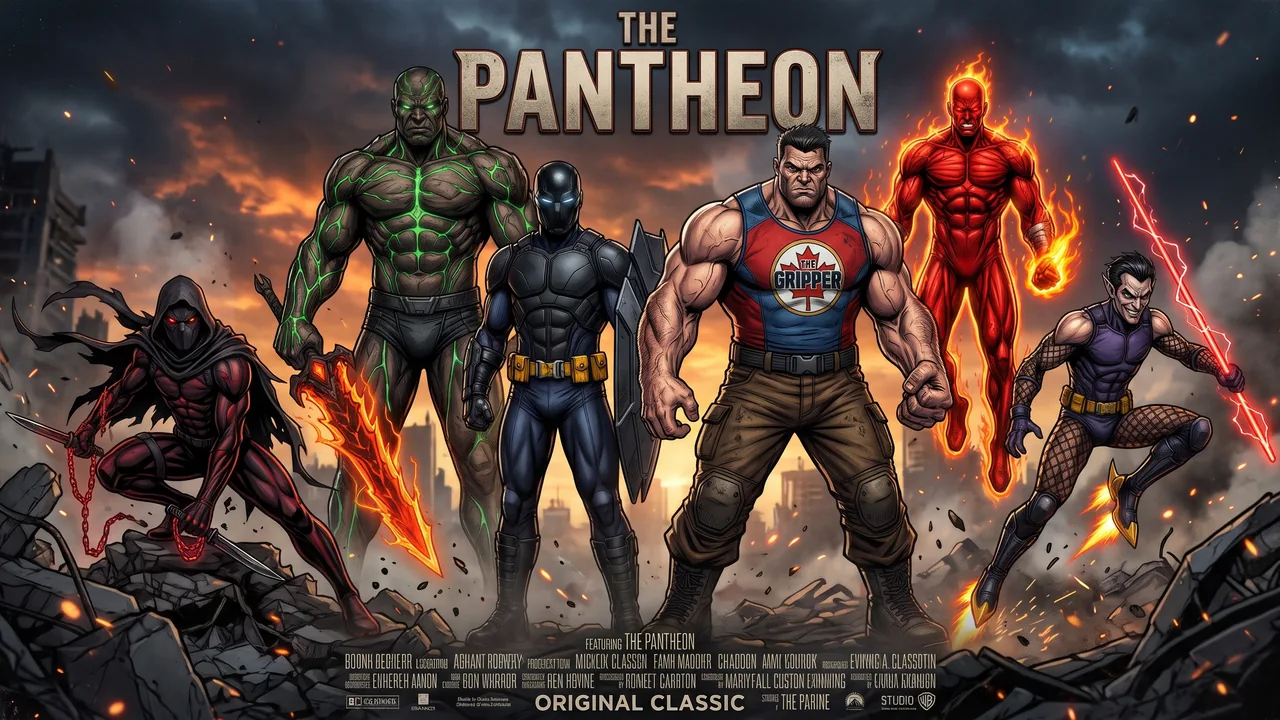
The short answer. Because we own them, and because an unbelievable event is the hardest thing to make provable. Argus Shield, Shadow, Crimson Warrior, Maroder, Quake and The Gripper are not a licensed property. They were drawn, named and written decades ago, for a tabletop game, by the person who signs the work on this site.
When you introduce infrastructure designed to prove physical reality, the last thing people expect to see is a team of comic-book superheroes. In our latest Verified Reality commercial campaigns you will notice appearances from Argus Shield, Shadow, Crimson Warrior, Maroder, Quake and The Gripper. People ask why a technology company focused on cryptography and forensic media verification uses a pantheon of super-powered characters to demonstrate its capabilities.
Where the pantheon came from
Decades ago, long before Bizbio or Verified Reality existed, these characters were created during my teenage years for a custom tabletop role-playing game. We spent hours developing their backgrounds, their tactical abilities and their visual designs. Because we built them from nothing, they are ours to deploy: no licence to buy, no third-party rights to clear, no franchise fee.
Why a verification company wants impossible fiction
The decision is strategic, and its origin is personal. To demonstrate the power of the infrastructure, we build attention-grabbing scenarios that push past the limits of believability. By putting fantastic fiction next to hard-nosed reality verification, the commercials make a point that no product diagram has managed to make.
If a brawler with hydraulic hands folds your warehouse girders in half, or a tectonic Titan splits your concrete slab, a standard photo in an email thread is not going to cut it. You need independently verifiable documentation — and the stranger the claim is, the more that matters.
What the commercials are actually demonstrating
These heroes allow us to depict extreme, world-shaking damage while demonstrating a very real system. The fantasy on screen grabs your attention; the technology sealing the record is the working part. On site, Verified Reality turns a standard smartphone into a hardware-attested capture device: the media, the device reading and the time it was taken are sealed together as the file is captured, with a cryptographic hash binding them. Anyone can re-check that seal later, and a match means the bytes still match the capture. The mechanism is shown on one job end to end — one person, one phone, and a client who can check the file without taking anybody's word for it.
What a seal does not do
It does not matter how unbelievable the event is. If it happened in the physical world, there is now a file that says where and when it was captured, and anyone can check that claim without asking us first. What that file does not do is decide what happened, or who should pay for it. No capture system closes every future attack; what this one does is make the hole expensive and visible, and review still judges the event.
We use impossible fiction to prove physical reality.